
Many international students assume that studying in the United States is only possible for families with strong financial resources. As a result, quite a few people put their study-abroad dream on hold because of cost concerns. But after living and studying in the U.S., I realized that there are actually many ways to reduce the cost of studying abroad — options that a large number of international students have used successfully. Below are some of the most important forms of financial support international students should consider when preparing their applications.
Financial support from universities
This is often the most important source of funding. Financial support for international students usually comes in the form of tuition discounts and institutional scholarships.
Selection criteria are typically based on merit, including GPA, IELTS or TOEFL iBT scores, academic achievements, extracurricular involvement, and application essays. In some cases, international students may also receive need-based support. Often, university funding is considered directly through your admission application and included in your offer letter, although some schools may ask for additional documents.
Each university has its own scholarship policy. Top private institutions, especially Ivy League schools, often offer stronger need-based aid for international students. [Harvard University](), for example, is widely known for offering substantial need-based support. Other universities may focus more heavily on merit-based scholarships tied to academic performance and extracurricular achievements.
One important thing to remember is that scholarships for international students are usually limited and highly competitive. Private universities — especially highly selective ones — often have more funding available for international students than public universities.
Academic assistantships
This is one of the best forms of financial support available. Unlike many government scholarships, assistantships usually do not come with post-graduation obligations. Students in assistantship roles often receive full or partial tuition waivers along with a monthly stipend. These opportunities are much more common at the graduate level — especially for master’s students and, more often, PhD students. Assistantships typically include Teaching Assistant (TA) and Research Assistant (RA) positions.
On-campus jobs
For on-campus jobs, international students are generally allowed to work up to 20 hours per week during the academic term without needing a separate work permit. Typical pay ranges from about $10 to $20 per hour. While that income is not enough to cover tuition, it can help with part of your living expenses. Common on-campus jobs include working in the library, cafeteria, gym, or university offices.
Off-campus jobs
International students on F-1 visas are generally not free to work off campus without authorization. To work legally off campus, students usually need CPT (Curricular Practical Training) or, in some cases, Pre-Completion OPT. These jobs must be directly related to the student’s field of study and approved by the school. In addition to bringing in some income, these opportunities can help you build experience and professional connections.
You should also not overlook scholarship and financial support opportunities offered by your home government. In addition, the U.S. government sponsors several scholarship and exchange programs for international students through its embassies around the world. International organizations such as the World Bank also provide funding opportunities for students from developing countries who wish to pursue graduate study in the United States. Well-known examples include the Fulbright Program, Hubert H. Humphrey Fellowship Program, and the Joint Japan/World Bank Graduate Scholarship Program (JJ/WBGSP).
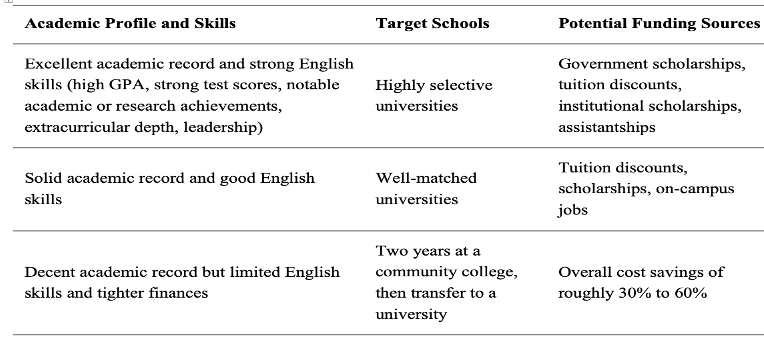
Studying in the United States is definitely expensive and often comes with financial pressure. But not everyone needs a full scholarship in order to make it possible. In many cases, combining several smaller sources of support — from tuition discounts and on-campus jobs to assistantships — can significantly reduce the overall cost of the journey.