The United States offers assistance programs specifically for refugees and certain groups protected on humanitarian grounds. Unlike general community assistance programs, these programs may have distinct requirements related to immigration status, the date eligibility begins, and the length of time benefits are available.
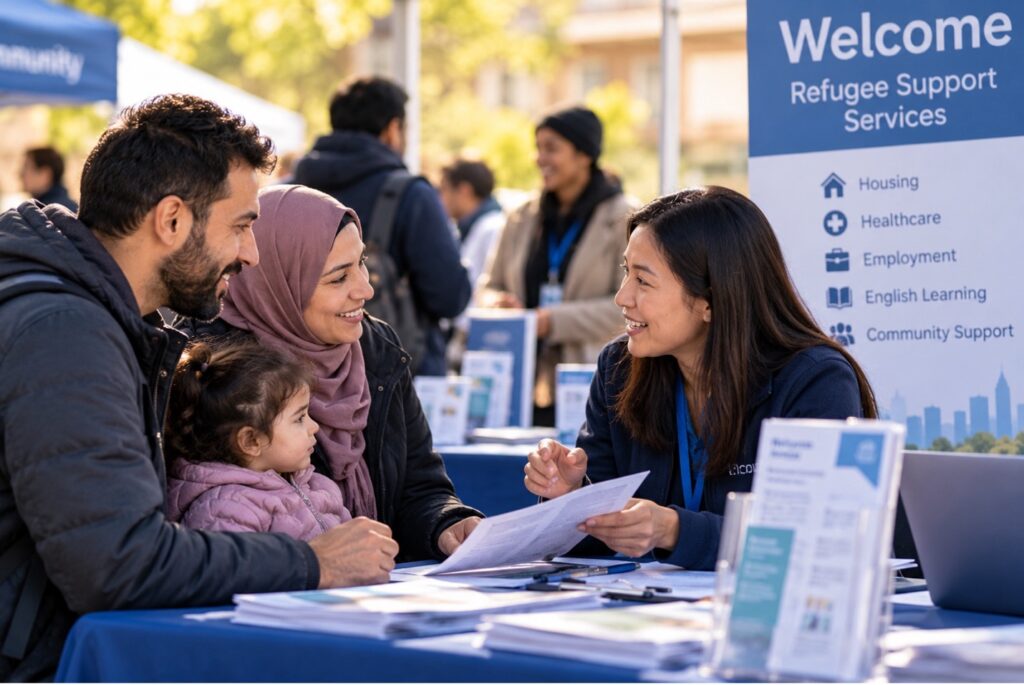
These programs are designed to help eligible individuals establish stable lives, access essential services, find employment, and gradually achieve financial self-sufficiency.
This article provides an overview of the U.S. refugee assistance system, specialized programs, eligibility requirements, and ways to find support.
1. How Does the Refugee Assistance System Work?
The Office of Refugee Resettlement (ORR), part of the U.S. Department of Health and Human Services (HHS), is the federal agency responsible for many assistance programs serving refugees and other eligible humanitarian groups.
ORR works with state agencies, designated program administrators, and nonprofit organizations to provide or fund support services.
Under a federal decision issued in 2025, responsibility for administering the initial domestic resettlement program was transferred from the U.S. Department of State to ORR within HHS. The program is now known as the Program of Initial Resettlement (PIR).
It is important to distinguish between two types of assistance:
- Initial resettlement assistance: Helps newly arrived refugees meet essential needs and adjust to life in the United States.
- Post-resettlement assistance programs: May include financial assistance, medical support, employment services, and other specialized programs for eligible individuals.
Not all programs are provided directly by the same organization or have the same eligibility requirements.
2. Specialized Assistance Programs
Refugee Cash Assistance (RCA)
Refugee Cash Assistance is a time-limited cash benefit for individuals who meet the program’s requirements, including income limits and other applicable rules.
RCA generally serves people who are not eligible for certain mainstream cash assistance programs, such as Temporary Assistance for Needy Families (TANF) or Supplemental Security Income (SSI), depending on the applicable rules.
The benefit is intended to help participants cover some living expenses during a transitional period. Benefit amounts and application procedures may vary by state or administering agency.
Refugee Medical Assistance (RMA)
Refugee Medical Assistance provides time-limited medical coverage to certain eligible individuals who do not qualify for Medicaid.
RMA can help participants access covered health care services during their eligibility period.
Individuals seeking medical assistance will be screened for Medicaid and RMA eligibility under the current rules where they live.
Refugee Support Services (RSS)
In addition to cash and medical assistance, ORR funds services that help refugees and other eligible groups achieve financial self-sufficiency and establish stable lives.
Depending on the program and location, services may include:
- job-search assistance and vocational training;
- English-language instruction;
- case management and service referrals;
- interpretation assistance;
- support with community integration; and
- certain services related to health care, transportation, or child care.
These services may have different time limits from RCA and RMA. Losing eligibility for cash assistance does not necessarily mean that a person can no longer access any other support services.
Some ORR programs also focus on groups with particular needs, such as older adults, children, young people, or individuals who require more intensive support.
3. Who May Be Eligible for Assistance?
ORR-funded programs are not available to all immigrants. Depending on the program and current rules, potentially eligible groups include:
- Refugees: Individuals admitted to the United States as refugees through the refugee admissions program.
- Asylees: Individuals who were granted asylum after applying within the United States or at a port of entry.
- Certain other humanitarian groups: These may include certain Special Immigrant Visa (SIV) holders, victims of severe forms of human trafficking, and other groups deemed eligible under the law or by ORR. Eligibility rules for humanitarian groups may differ from those that apply to refugees and asylees.
Both refugees and asylees may qualify for certain ORR programs, but the date on which their eligibility period begins may differ.
People with pending asylum applications (asylum applicants) are not automatically eligible for ORR programs intended for individuals who have already been granted asylum.
In addition to immigration status, eligibility may depend on income, place of residence, the date the eligibility period begins, and whether the person is receiving assistance from another program.
4. Duration and Conditions of Assistance
There is no single time limit that applies to every refugee assistance program.
According to a notice published by the Office of Refugee Resettlement (ORR) in the Federal Register on October 1, 2026, the eligibility period for Refugee Cash Assistance (RCA) and Refugee Medical Assistance (RMA) was revised to 12 months, replacing the eight-month period announced in July 2026. Program administrators were directed to implement the change within 30 days of publication.
The 12-month period represents an eligibility window, not a guarantee that every individual will receive benefits throughout that entire period. Actual eligibility depends on immigration status, the applicable eligibility start date, and other program requirements.
[1]Because policies may continue to change, participants should confirm the applicable duration, eligibility start date, and specific benefits with the local program administrator before making financial or health care plans.
5. Where Can You Find Help?
If you or your family may belong to an eligible group, start with the following resources:
Office of Refugee Resettlement (ORR)
ORR’s official website provides information about programs, eligible groups, and state assistance systems.
State Refugee Program Office
Depending on where you live, the program may be administered by a state agency or an organization designated by ORR.
Resettlement Agencies and Nonprofit Organizations
These organizations may help eligible individuals understand available programs, prepare documentation, and connect with employment, medical, and community support services.
When you contact an organization, consider asking:
- Do I belong to a group that is eligible for this program?
- When does my eligibility period begin?
- Can I apply for RCA, RMA, or other assistance programs?
- What documents do I need to prepare?
- If I do not qualify for cash or medical assistance, what other services may still be available to me?
Key Points to Remember
U.S. refugee assistance programs have their own eligibility requirements and benefits, which differ from those of general community support services.
RCA and RMA are time-limited assistance programs. In addition, some eligible individuals may be able to access employment services, English-language instruction, and integration support through ORR-funded programs.
Not every immigrant or asylum applicant qualifies. Specific benefits depend on immigration category, individual circumstances, and current rules.
Frequently Asked Questions
1. Do refugees automatically receive RCA and RMA?
No. Participants must meet the requirements of each program. Some people may qualify for TANF, SSI, or Medicaid instead of RCA or RMA.
2. Are refugees and asylees eligible for the same assistance programs?
Both groups may qualify for certain ORR programs. However, the date on which the assistance period begins and the specific requirements may differ.
3. After my RCA or RMA eligibility ends, can I still receive other support?
Some employment, education, or community support services have separate eligibility requirements and time limits. Participants should contact the administering organization to confirm what remains available.
4. Are refugees authorized to work in the United States?
Yes. Individuals admitted as refugees and those granted asylum are authorized to work under federal law. The documents used to verify employment authorization may vary by case.
5. What should I do if I am not sure whether I qualify?
Contact your state refugee program office or an authorized support organization for guidance. Do not determine your eligibility solely on the basis of information from friends or acquaintances.
Official Information Sources
For detailed information about refugee assistance programs, eligibility requirements, and how to access services, consult the following official sources:
| Source | Information Provided |
| Office of Refugee Resettlement (ORR) | The federal agency that administers assistance programs for refugees and certain eligible humanitarian groups. |
| Cash and Medical Assistance (CMA) | Information about cash and medical assistance, including Refugee Cash Assistance (RCA) and Refugee Medical Assistance (RMA). |
| Refugee Support Services (RSS) | Information about employment support, training, English-language instruction, and services that promote stability and self-sufficiency. |
| ORR – Policy and Guidance | Program policies and guidance, including eligibility rules for humanitarian groups. |
| Federal Register | Federal notices and regulatory changes, including changes to RCA and RMA assistance periods. |
| U.S. Citizenship and Immigration Services (USCIS) | Information about immigration status, refugee and asylum classifications, and related procedures. |
Note: Eligibility requirements, benefit periods, and assistance amounts may vary by program and are subject to current rules. Before applying, individuals should confirm the information with the state program administrator or designated organization.
Information reviewed in October 2026. Programs, time limits, eligibility requirements, and funding sources may change. Check the latest guidance from ORR or the program administrator where you live.
Checklist: Finding Refugee Assistance in the United States
Use this checklist to prepare before contacting agencies or organizations that provide assistance to refugees and other eligible humanitarian groups in the United States.
Important: This checklist is intended for informational and preparation purposes only. Completing the steps does not establish eligibility for benefits. Contact the appropriate program administrator for guidance based on your individual circumstances.
[1] Source: Federal Register, Period for Refugee Cash Assistance and Refugee Medical Assistance; Correction, 91 FR 62534 (October 1, 2026).